
How can regional network operators benefit from advanced network automation without investing in large proprietary platforms? Discover how Wexnet and Ductus built an open, modular automation platform for the networks of tomorrow.
In brief
Challenge
Wexnet wanted to improve operational efficiency, reduce manual work, and establish a scalable foundation for future service development—without becoming dependent on a specific vendor or platform.
Solution
A modular automation platform built on open standards, where NetBox, Camunda, and Clixon Controller together enable data-driven and vendor-neutral network automation.
How we did it
We established a common information model in NetBox and built an architecture that separates data, processes, and network execution, enabling the gradual adoption of automation capabilities.
Benefits
Faster service delivery, improved quality, reduced operational risk, and a future-proof platform that can evolve alongside changing business and network requirements.
About the client
Wexnet’s mission is to create value for businesses and households across the region through innovative thinking and an open fiber infrastructure. By collaborating closely with customers, contractors, and technology partners, Wexnet delivers a profitable and cost-efficient open access fiber network. Our vision is to create lasting societal value by providing an open digital infrastructure that benefits everyone.
Automation Is Not Just for the Largest Operators
Network automation is often associated with the largest service providers and ambitious transformation programs. Yet the operational challenges that drive automation are not unique to large operators.
Regional network operators such as Wexnet face many of the same demands: growing service portfolios, multi-vendor environments, increasing customer expectations, and the need to deliver changes quickly, consistently, and with high quality. In many respects, the need for automation is just as important.
At Ductus, we believe that the industry needs to broaden access to automation. The benefits of automation—faster service delivery, improved quality, reduced operational risk, and greater scalability—should not be confined to organizations with the resources to deploy large, monolithic platforms. Modern automation capabilities should be accessible to a much wider range of operators.
This belief is one of the reasons why we are working together with Wexnet to build a modular automation platform based on open standards and open-source technologies.
“Our objective is not automation for its own sake. We want to improve the quality and efficiency of our operations while maintaining the flexibility to evolve our network and services over time. A modular architecture gives us the freedom to adapt as requirements change, without becoming dependent on a single platform or vendor.”
— Håkan Larsson, Development Manager Wexnet
Automation Driven by Business Objectives
For Wexnet, automation is not primarily a technology initiative. It is an enabler for achieving broader operational and business goals.
From the outset, two high-level requirements guided the initiative:
- A modular architecture built on open standards and well-defined interfaces.
- Improved correctness and efficiency through automation and standardization.
These objectives also align with Sweden’s broader digitalization strategy, particularly the goals related to secure digital infrastructure (D-infrastruktur), innovation (D-innovation), and digital resilience (D-trygghet). The solution is primarily focused on strengthening digital infrastructure through improved operational efficiency and service delivery, while also creating a foundation for faster innovation and maintaining a strong focus on security and operational control.
Over time, the same automation foundation can also support increased digitalization of customer-facing processes, giving customers and partners greater visibility into service delivery and operational status.
Starting with Data, Not Orchestration
For us, automation does not begin with orchestration. It begins with data.
At the heart of the solution is a carefully modeled NetBox implementation that serves as the network’s authoritative source of truth. By consistently modeling services, resources, relationships, and operational data, NetBox provides the foundation upon which all automation capabilities are built.
This approach ensures that automation is driven by well-defined models of services, resources, and relationships rather than device-specific configurations or vendor-specific implementations. It also creates a common understanding of the network across engineering, operations, and automation systems.
A strong source of truth enables automation to scale because every process, workflow, and service can rely on the same trusted data.
The Solution Architecture
The solution architecture is built around a clear separation of responsibilities.
NetBox serves as the authoritative source of truth for services, resources, and inventory data. Camunda orchestrates business and operational workflows using information from NetBox and coordinates the execution of automation processes.
Within Clixon Controller, vendor-neutral service models translate service intent into standardized network representations. These service models are then mapped to vendor-specific device models that interact with the underlying network platforms. This allows higher-level workflows to remain focused on services and intent while Clixon Controller handles the translation to the capabilities and data models of individual vendors.
As a result, automation workflows remain independent of underlying network technologies while ensuring that all actions are based on trusted and consistent data.
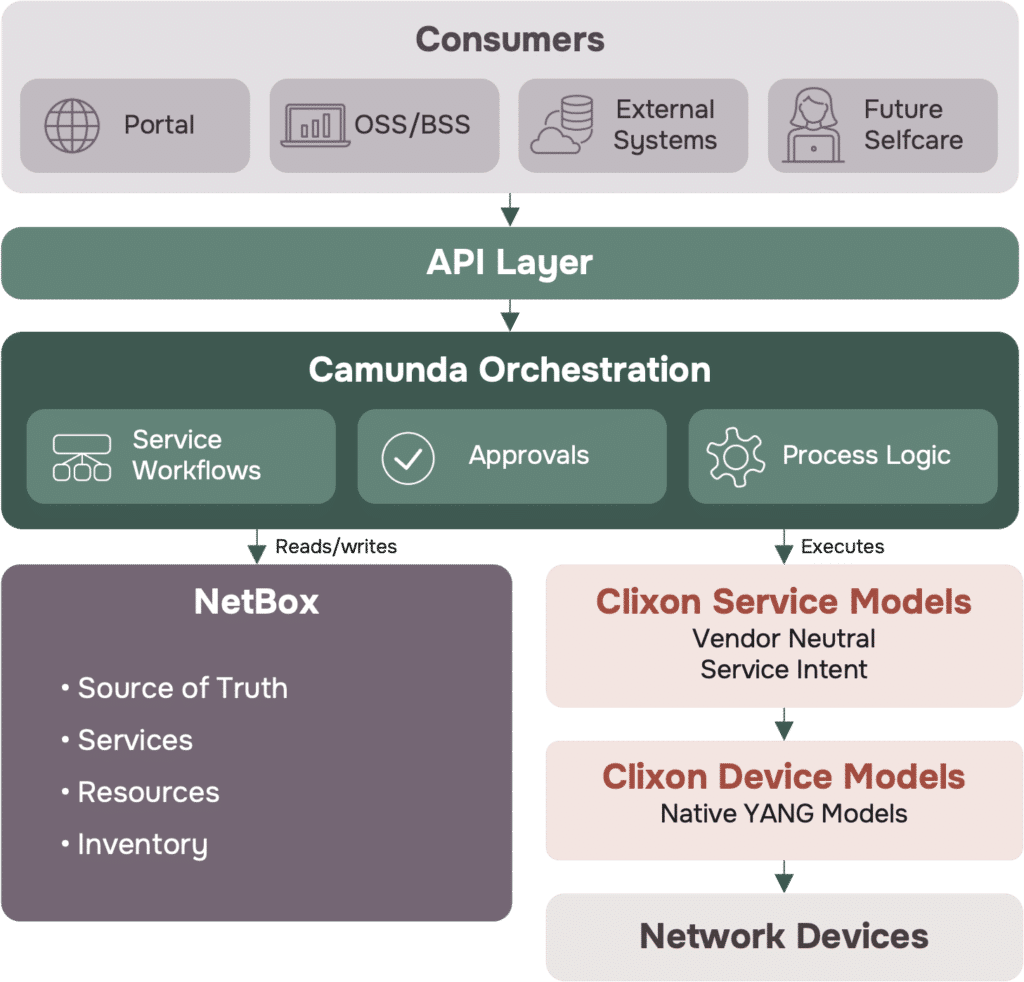
This architecture reflects one of the core principles behind the initiative: data drives decisions, workflows drive actions, and standardized abstractions drive network execution.
Each layer contains only the information required to fulfill its responsibility. Higher layers focus on services and intent, while implementation-specific concerns are delegated to the components responsible for executing them. By separating these concerns, each component can evolve independently while remaining part of a coherent automation platform.
A Modular Architecture Built on Open Standards
Around the source of truth, we have built a modular architecture where each component has a clear responsibility.
Camunda provides workflow orchestration and process automation, enabling business and operational processes to be implemented independently of the underlying network technology.
Clixon Controller provides a network abstraction layer built around vendor-neutral service models and vendor-specific device models. This allows higher-level systems and workflows to remain focused on service intent while Clixon Controller handles the translation to the capabilities and data models of individual network platforms.
Because these components are loosely coupled, they can evolve independently while continuing to operate as part of a coherent automation platform.
This modular approach allows Wexnet to introduce new capabilities incrementally and focus investments where they deliver the greatest operational value.
Making Automation Accessible
For us, this project is about more than technology.
It is about making proven automation principles and advanced automation capabilities accessible to a broader segment of the telecom industry.
Too often, advanced automation has been perceived as something reserved for the largest operators. Our experience shows that this does not have to be the case. By combining open standards, open-source technologies, and a well-designed architecture, operators can achieve significant automation outcomes without being dependent on large, proprietary platforms.
The goal is not to replicate the architectures of the world’s largest service providers. The goal is to provide operators with an automation platform that fits their operational reality, supports their business objectives, and can evolve alongside their network.
A Blueprint for Modern Network Operations
The challenges facing Wexnet are shared by many regional and alternative network operators. They need to deliver services faster, operate more efficiently, and scale their operations without increasing complexity.
Our work together demonstrates that there is another path forward—one built on open standards, modular design, and a strong source of truth.
Because the need for automation is universal.
Access to automation should be too.